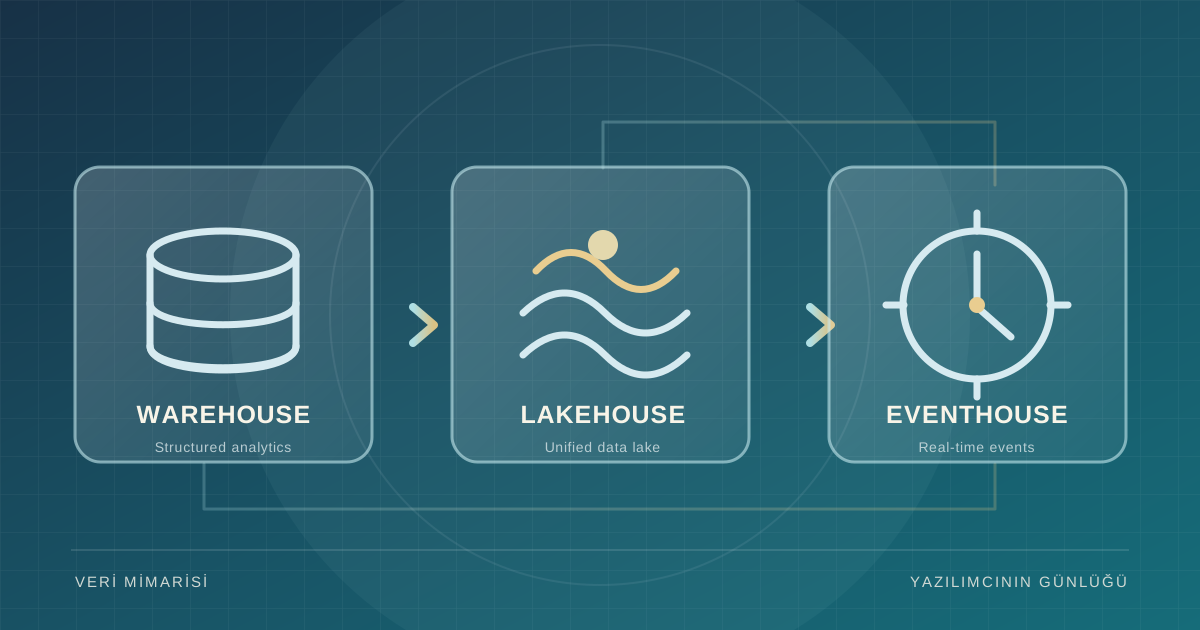
Microsoft Fabric architecture: when to choose Warehouse, Lakehouse, or Eventhouse
Avoid forcing every workload into one store. Choose between SQL analytics, file-based engineering, and real-time event processing according to the workload.
Start with the workload, not the product name
When an organization adopts Fabric, the first question should not be which component sounds newest. Ask how the data is produced and consumed. Management reporting often needs relational, governed SQL queries. Data engineering teams may work with raw files, semi-structured records, and Spark transformations. Factory sensors require low-latency analysis of events arriving every second. Having these workloads on one platform does not mean they should all use the same engine.
Warehouse: a managed relational analytics layer
Fabric Warehouse is suited to relational analytics built with T-SQL, including dimensional models, fact and dimension tables, controlled ingestion, and Power BI reporting. It provides a familiar surface for SQL teams. However, it does not need to be the landing zone for every raw file. Source formats, transformation needs, governance, and query patterns should guide the choice.
Lakehouse: from files to Delta tables
A Lakehouse combines files and managed Delta tables on OneLake. Teams can retain CSV, JSON, or Parquet sources, validate them with Spark or SQL, and publish curated analytical tables. Bronze, Silver, and Gold layers make responsibilities explicit. Lakehouse is a strong center for semi-structured data, data science, large transformations, and workloads where several engines need to consume the same tables.
Eventhouse: time series and event streams
Eventhouse is designed for high-volume timestamped events such as telemetry, application logs, security records, and IoT data. KQL queries, time windows, and event analysis can be more suitable than a conventional reporting query. For example, use Eventhouse to inspect temperature, vibration, and downtime events on a production line in near real time. Do not choose it as the default dimensional warehouse for monthly financial close.
A combined architecture and decision checklist
These components do not have to compete. Operational events can flow into Eventhouse, cleaned history can be retained in Lakehouse, and approved business measures can be exposed through Warehouse or a semantic model. Document latency targets, data formats, concurrency, access rules, team skills, and capacity cost. Measure a representative workload before moving the whole organization into one pattern.
Validate platform choices against real workloads
Choose Warehouse, Lakehouse, Eventhouse or another processing layer from workload requirements: query patterns, event latency, file sizes, data quality and access controls. Build a representative pilot and compare at least two suitable architectures using the same criteria. Document update, deletion, versioning and retention semantics before treating a demonstration as production-ready.
Manage capacity and ownership together
Analytics cost includes compute, refresh frequency, failed-job retries, replicated models and access control, not only storage volume. Track cost alongside data freshness and user-facing latency. Assign an owner, service target, schema-change policy and incident process to each dataset. Scale capacity only after evidence identifies the actual bottleneck.
Comments
No comments yet. Be the first to contribute.
Try the comment interactions · demo preview
The two examples below are only a UI demo, not real visitor comments. Likes and replies are local to this page and are not saved; use the real form below to post.
I'd like to see which steps benefit most in real deployment.
An example test scenario would make the technical analysis clearer.
✎ Write a comment