BepiColombo enters Mercury orbit as ESA investigates shortened burn
The ESA–JAXA mission entered Mercury orbit on November 21. ESA says the craft is safe after a software issue shortened the thruster burn.
A new stage after eight years
The European Space Agency and Japan Aerospace Exploration Agency's BepiColombo mission was captured into orbit around Mercury on November 21, 2026. Launched in 2018, it became only the second mission to orbit the planet. The two science craft remain attached at this stage: ESA's Mercury Planetary Orbiter, or MPO, and JAXA's Mercury Magnetospheric Orbiter, known as Mio, have not yet separated into their individual science orbits. The Associated Press reported that controllers in Germany confirmed the capture after several hours assessing data.
Successful capture with a shorter burn
On November 22 ESA said the spacecraft had reached orbit, but a software issue caused the thruster burn to be shorter than planned. The agency said the spacecraft was safe and teams at the European Space Operations Centre were investigating. Reuters and Space.com reported the update. ESA had not yet published a root cause, definitive orbital parameters or an assessment of the consequences for later maneuvers. Neither a failed mission nor an entirely nominal maneuver is supported by the available information.
Why Mercury takes so much work to reach
Traveling toward the innermost planet means falling deeper into the Sun's gravitational field and gaining speed. A spacecraft must shed enough energy for Mercury's comparatively weak gravity to capture it. BepiColombo's route used one flyby of Earth, two of Venus and six of Mercury to help reshape its trajectory over the long cruise. Reduced power available to the electric propulsion system also led the team to revise the schedule. A flyby and capture into an orbit are distinct mission milestones.
Two complementary spacecraft
MPO is designed to study the planet, including its surface and interior, while Mio focuses on the magnetic environment. Measurements from different locations at the same time can help scientists investigate how Mercury's magnetic field interacts with the solar wind. Questions include the planet's large iron core, the origin of its magnetic field and its geological features. These are research objectives, not results already obtained from the new orbit. The mission also faces significant thermal engineering challenges close to the Sun.
Separation and science are still ahead
ESA's published schedule calls for the two probes to separate on December 9–10, 2026, with further steps including release of Mio's protective structure. MPO needs additional maneuvers to reach its final orbit, and routine science is planned to begin in April 2027. These dates are plans that could change after the shorter burn is assessed. Orbital capture does not mean the probes have separated or that the science phase has started.
What to watch next
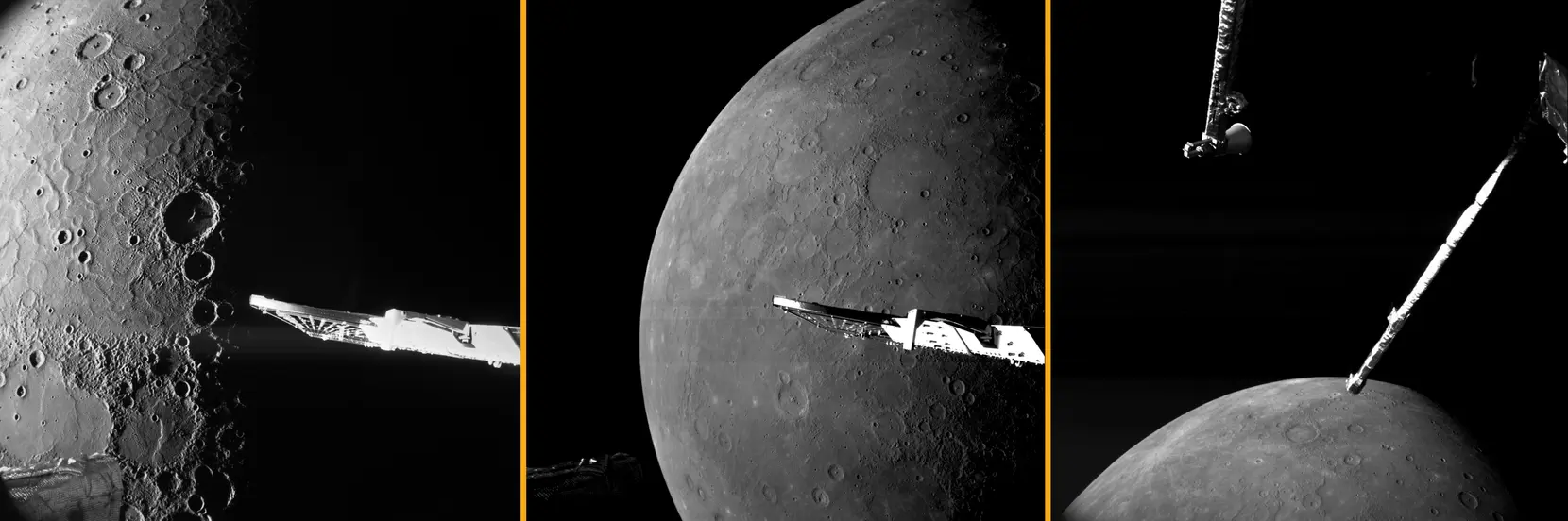
Mission controllers must explain the software issue, assess the achieved orbit and identify any necessary correction. Later milestones include separation, final-orbit maneuvers and instrument operations. ESA's mission timeline supplies the planned sequence; AP and Space.com independently report the capture and the agency's update. BepiColombo returned imagery during earlier Mercury flybys, which should not be mistaken for pictures from the newly achieved orbit. The cover comprises archive images from BepiColombo’s January 8, 2025 Mercury flyby, not images of the 2026 orbital maneuver. Image: ESA/BepiColombo/MTM, CC BY-SA 3.0 IGO.
Photo: ESA/BepiColombo/MTM (2025; CC BY-SA 3.0 IGO) / Unsplash ↗
Sources and verification
- Primary sourceESA Operations — görev güncellemesi ↗
- Technical documentESA — görev takvimi ↗
- Technical documentESA/BepiColombo/MTM — görsel ve lisans ↗
- Reporting / cross-checkAssociated Press — Marcia Dunn (NBC Chicago) ↗
- Reporting / cross-checkSpace.com — Mike Wall ↗
Comments
Editorial question: Which data would you want ESA to share when assessing the shortened burn?
Share your thoughts ↗No reader comments yet. Be the first to share your view.
Write a comment