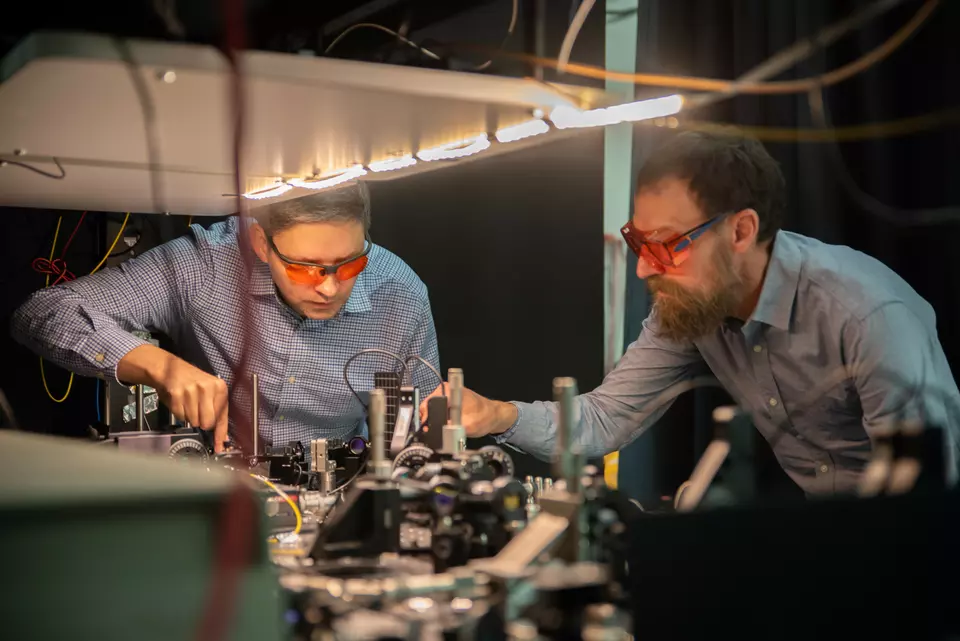
NIST tests quantum position verification with entangled photons
A study published November 18 describes a laboratory test using entangled photons and timing. Real-world applications require further quantum-network development.
A laboratory result, not a location app
Researchers led by the US National Institute of Standards and Technology have tested a protocol that uses quantum correlations to verify where a measurement takes place. Their paper appeared in Nature on November 18, 2026; the sources do not give the exact day the experiment was performed. Two trusted verifying stations challenge a third party claiming to be at a specified location. The work addresses a security problem in which remote collaborators try to imitate a participant at that location. It is a laboratory demonstration, not a consumer location-verification service.
How the experiment worked
On the NIST campus in Boulder, the two verifying stations were 195 meters apart, connected by electrical cables and optical fibers through a research building. One verifier generated an entangled pair of photons, retained one and sent the other toward the party whose position was being checked. Both verifiers sent random instructions timed to reach the expected position simultaneously. The participant used those instructions to choose a polarization measurement and returned the result. The verifiers compared response timing and correlations between their measurements. The procedure was repeated millions of times over several minutes.
Why timing and a Bell test matter
The protocol combines signal travel time with a Bell test, which checks whether observed correlations exceed what a classical explanation permits. Since the measurement instructions are random, a remote adversary cannot simply know the required answer in advance. The quantum no-cloning principle also constrains attempts to copy and distribute the relevant quantum information to collaborators. The researchers' approach reduces reliance on trusting the devices themselves, but its guarantees must be read alongside the protocol's assumptions and specified attacker model.
What the reported comparison means
The Nature paper says the experimental version was tested against adversaries that were weakly entangled before each trial. It reports a one-dimensional localization interval 2.47 times smaller than the best classical comparison, and a localization volume 4.53 times smaller than classical protocols with the same latencies. These are results for the stated experimental benchmarks. They do not establish that every deployment will obtain the same improvement or defeat every conceivable attack. Losses, detector behavior, communication delays and network geometry will matter in any follow-up.
Why deployment remains distant
NIST identifies superconducting nanowire single-photon detectors and an efficient entangled-photon source as enabling components. Excessive photon loss can prevent an honest participant from passing the test. Useful networks would need stable quantum links, sensitive detection and precise timing across practical distances. A NIST collaborator says real-world use may be more than a decade away because large-scale quantum networking tools are still being developed. Protecting financial commands, infrastructure or private records are potential applications, not services demonstrated by this experiment.
What to watch next
The peer-reviewed paper documents the setup, assumptions and comparison; NIST supplies details of the campus implementation and remaining engineering challenges. Live Science independently reported the research. Together they support a report about a newly published experimental result, not a finished commercial security product. Future evidence should include replication, tests under stronger adversary models, longer links and integration with operational systems. Exact conditions and uncertainty remain as important as the headline performance figures.
Photo: Riley Wilson/NIST / Unsplash ↗
Sources and verification
- Primary sourceNIST — kurum açıklaması ↗
- Primary sourceNature — hakemli araştırma ↗
- Reporting / cross-checkLive Science — bağımsız haber ↗
Comments
No reader comments yet. Be the first to share your view.
Write a comment