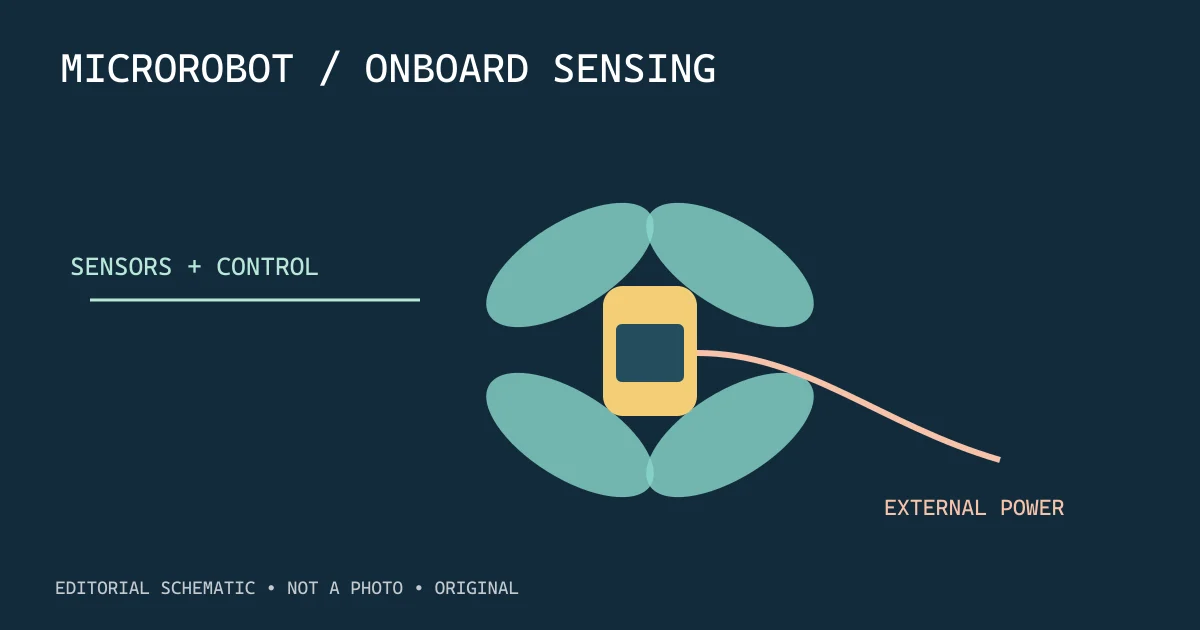
Microrobot sunflower flight used onboard sensors but offboard computing
MIT and Cornell tested flight without motion capture and onboard computation in separate trials; power remained external.
Onboard sensing in a tiny aircraft
MIT and Cornell researchers demonstrated a flapping-wing aerial robot that estimates motion from onboard sensors rather than relying on a laboratory motion-capture system. The work appeared in Science Robotics on November 18, 2026. In separate flights the approximately 1.29-gram robot carried both sensing and computation. A different 30-second flight ended with a sunflower landing using onboard sensors but offboard computation, according to the authors’ detailed preprint. Both configurations used external power. This is a research demonstration, not a self-powered or deployable agricultural product.
A human command and an external power source
The preprint describes a human operator supplying high-level commands in the sunflower flight; an external computer processed the onboard sensor readings and control calculations. That flight without motion-capture input must be distinguished from separate trials in which the estimator and controller were also carried onboard. MIT says the robot remained connected to an offboard power source. External cameras, computation and electrical supply are different dependencies. Removing the tracking cameras did not make the sunflower experiment self-contained.
What the sensor package does
MIT reports that the electronics include an inertial measurement unit for attitude, an optical-flow sensor for lateral motion, and a time-of-flight sensor for height. A microcontroller processes the measurements as the vehicle moves. Each device addresses a different part of the estimation problem: height alone cannot explain sideways drift, and optical flow does not automatically supply an absolute position. The researchers designed fast estimation and control to operate within a severe weight and computation budget. The paper reports centimeter-scale flight accuracy in its experimental conditions.
The weight budget
The sensor and computing package weighs 244 milligrams according to MIT. Carrying it on an aircraft whose total reported mass is 1.29 grams required more lift without losing the ability to maneuver. The team adjusted the geometry of the soft actuators that flap the four wings, and MIT reports a lift-to-weight ratio of 1.9. That figure describes the researchers' test, not guaranteed performance in all environments. The electronics were secured to a substrate to reduce the risk that wing vibrations would dislodge them.
What the demonstration establishes
The journal abstract describes a 30-second flight and landing outside a motion-capture environment. The authors’ detailed preprint specifies that this particular demonstration used onboard sensing with offboard computation; onboard computation was evaluated in separate flights. Independent coverage by JetsonsAge highlights that distinction, the operator's role and the power tether. The experiment does not establish all-day outdoor operation, actual pollination, or reliability across wind and weather. Energy storage, navigation, durability and safety remain engineering questions between a controlled demonstration and practical field use.
Potential uses and next steps
The research team points to possible applications including monitoring plants and inspecting confined spaces. These are prospective uses, not reported commercial deployments. A future greenhouse system would need to avoid damaging plants, operate under changing light and maintain safe separation from people. Outdoors, wind and changing surfaces would add challenges for motion estimation. The paper was shared as a preprint in February 2026 and published in Science Robotics in November; those are distinct milestones. Onboard power and more onboard planning remain future problems without a firm deployment timetable. The cover is an original editorial schematic, not a photograph of the experimental robot.
Photo: Yazılımcının Günlüğü (özgün editoryal şema) / Unsplash ↗
Sources and verification
- Primary sourceHsiao ve diğerleri — araştırma ön baskısı ↗
- Primary sourceMIT News — araştırma ekibi açıklaması ↗
- Reporting / cross-checkJetsonsAge — bağımsız teknik haber ↗
- Reporting / cross-checkOriginal publisher ↗
Comments
Which data would you verify before applying this development in your field?
Share your thoughts ↗No reader comments yet. Be the first to share your view.
Write a comment