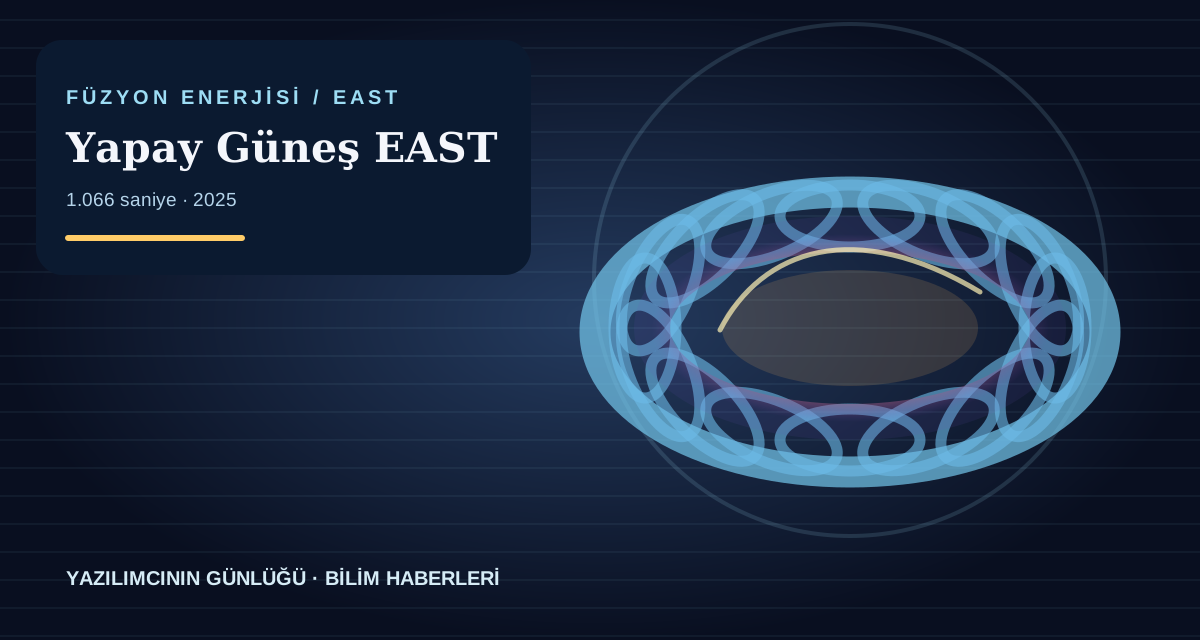
China's EAST Tokamak Maintains 100-Million-Degree Plasma for 1,066 Seconds
China's EAST magnetic-fusion experiment sustained high-confinement plasma for 1,066 seconds on January 20, 2025, exceeding its earlier 403-second result. This is a research milestone, not a commercial power plant.
What does “artificial sun” actually mean?
EAST, the Experimental Advanced Superconducting Tokamak, is a fusion research device operated under the Chinese Academy of Sciences. It uses powerful magnetic fields to confine extremely hot plasma while scientists study conditions relevant to fusion energy. The popular “artificial sun” nickname does not mean a new sun was built in the sky or that a commercial power station exists.
Why the 1,066-second result matters
On January 20, 2025, EAST sustained high-confinement plasma at roughly 100 million degrees Celsius for 1,066 seconds. The Chinese Academy of Sciences reported that this exceeded the earlier 403-second achievement from 2023. Longer stable confinement is a useful engineering and plasma-physics milestone. It does not, by itself, establish positive net electricity production.
The confinement challenge
Plasma at such temperatures cannot touch ordinary container walls. A tokamak uses toroidal magnetic fields to keep energetic particles away from its structure. Successful operation depends not only on temperature but also on stability, heat transport, interaction with the vessel and operational duration. A long plasma pulse is not equivalent to a grid-connected steady-state fusion plant.
What remains before commercial power?
Important engineering tasks still include exhaust heat management, materials durability, fuel handling, reliable maintenance and demonstrating a practical net energy balance. Experiments such as EAST help researchers measure and validate parts of this broader challenge. No guaranteed date for commercial, continuous electricity production follows from this record alone.
Source and chronology
The experiment took place on January 20, 2025, and the Chinese Academy of Sciences reported its result on January 21, 2025. The publication date of this article is displayed separately. Readers can follow the scientific institution's original announcement to distinguish the event date from subsequent analysis.
Comments
No comments yet. Be the first to contribute.
✎ Write a comment